

Think Tank Photo

Sunday, October 23, 2011
Anthony Abraham: Miami Auto Dealership Tycoon, Dead at 100


Tuesday, October 18, 2011
Dan Wheldon 1978-2011

Dan Wheldon 1978-2011
This is Wheldon driving car number 10 Target Chip Ganassi Racing and as he celebrates in Victory Lane after winning the Indy Car Series XM Satellite Radio Indy 300 at Homestead-Miami Speedway in 2007.

Sunday, October 2, 2011
What Makes You Click? Q & A with Brian Smith

By Al Diaz
aldiaz305@aol.comBack in the day, when shooting on film for the Miami Herald, photographers often made film runs for each other to meet deadline. The photographer would continue shooting while the first batch of Tri-X would get processed in our lab. On this day I made a run for Brian Smith at a late night press conference. There was Brian all set up with light stands and his portable Norman 200B’s on either side of the makeshift platform assembled for the speaker. I was amazed at how he would go through so much trouble to light up such a mundane event. No one else was doing it.
Q; Brian, what motivates you to strive for the extraordinary in your work?
It's probably just my mid-western work ethic showing through.
If you're going to do something - do it well.
Q; Who influenced you most in your career?
There are a lot of photographers who I look up to for different reasons. Gregory Heisler was a mentor for his expertise in lighting and the thought he puts into his portraits. George Hurrell and Irving Penn were two of my favorite portrait photographers. No one has ever captured Hollywood glamour better than Hurrell and Penn's portraiture continued to evolve through his remarkable career. Elliott Erwitt's photographs prove that photography is a great way to share a smile. Elliott loves what he does and it shows in every photograph he takes.
Q; You travel for days at a time and work long hours including weekends. So often that puts a strain on a marriage. How do you balance your busy schedule and family life with Fazia?
I've been extremely lucky to be able to work and travel with my wife Fazia for the past 20 years. You really need a crew on most portrait shoots and she's so versatile that she can do anything from hair & make-up to styling to production on our shoots allowing us to work and travel together as we collaborate on everything.
Q; What is your relationship with Sony and why?
I'm one of seven photographers in Sony's Artisans of Imagery program. We speak at schools and trade shows around the country. Sony approached me when they were developing their pro a900 camera. They gave me their previous camera and asked for feedback. I was blown away by the quality of their Zeiss lenses, so I gave them a list of what I thought should be included in the new camera. When the new camera came out with all the stuff I asked for I was even more impressed that they asked what they should do next.
Q; You have a talent for impersonations, has that ever helped you put a subject at ease?
Getting your subjects to laugh can really help the mood of a shoot, but since many of the people I shoot make people laugh for a living, I never try to upstage a professional. Of course it's a huge compliment when you make a comedian crack up.
Q: How did you begin to conceptualize the ART & SOUL book project?
Kayla Lindquist of Sony approached me with the idea for ART & SOUL which was to partner with The Creative Coalition to photograph stars during Oscars Week 2009 and get them to write in a journal something about what the arts means to them. From our very first shoot of Tim Daly we realized we'd struck gold. So we just kept shooting and building upon the idea. When an incredible great project gets dropped in your lap, you've simply got to take it all the way.
Q; Start to finish, how long did it take you to complete the book?
The book was shot in 20 days over a 15 month period. It then took another 6 months to get our publisher to green-light the book and then production took another 6 months for me to edit, retouch and lay the book out.
Q: Did all your photo sessions for the book go as planned?
Better than I could have possibly imagined. There was something really special about this project from the very start. Because the project was about the arts, so we naturally focused upon that first defining moment when the arts clicked for them. Even the most celebrated star were transported back to their first school play when their biggest stage was shared with school assemblies and their entourage and stretch limo were their friends in the back of mom's minivan.
Q: Regarding photography equipment used for ART & SOUL, what’s in the bag?
Sony a900 camera
Sony Zeiss 24-70/2.8 lens
Sony Zeiss 85/1.4 lens
Sony Zeiss 135/1.8 lens
Sony 100/2.8 Macro lens
PocketWizard Transceivers
Q: What’s your advice for a young photographer?
Learn to work with people. If you're going to be a photographer you have to know how to work with people. The best advice I was ever given was to go out and shoot portraits of 50 strangers that reveled something about who they were. It's an exercise that I've done throughout my career.
Q: Do you always hang out at nudist colonies?
Just for work...the true joy of portrait photography is meeting all types of people and finding a way to tell their stories. Sports Illustrated called with the best words a photographer can ever hear are "We have a shoot that is perfect for you.." the only way that gets better is if their next words are "Nudist Golf..."
Brian will be a guest speaker and available for book signing at:
8pm Thursday, October 20, 2011
Books & Books / Coral Gables
265 Aragon Avenue
Coral Gables, Fl. 33134
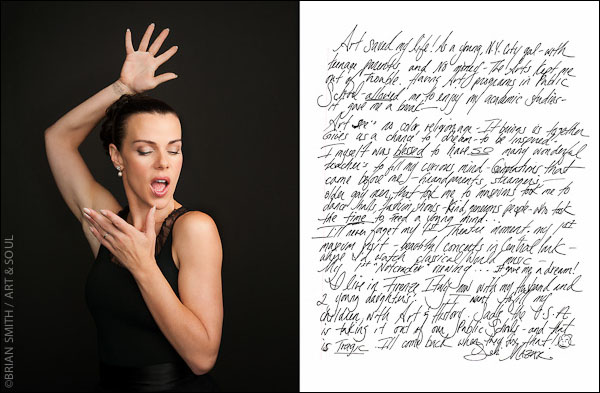
Art & Soul: Stars Unite to Celebrate and Support the Arts
By Brian Smith, Robin Bronk
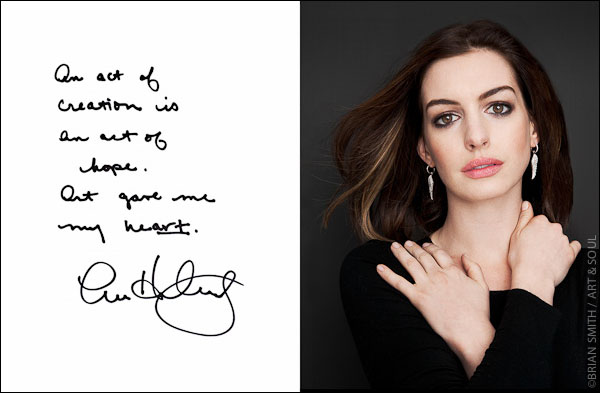
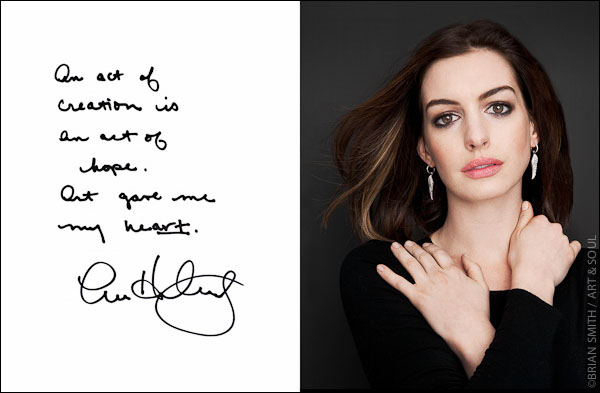
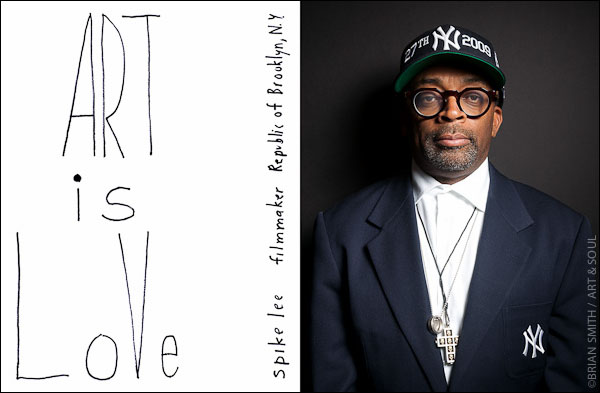
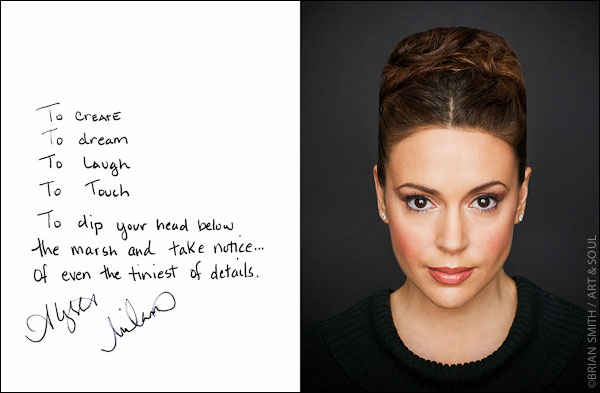
ART & SOUL is a large-format glossy coffee-table book, featuring intimate portraits of celebrities from the entertainment industry including film, television, music and stage. The stunning images, shot by Pulitzer prize-winning photographer Brian Smith, are accompanied by personal testimonials from each artist expressing the importance of the arts in our culture and the positive impact it has on our lives.
The notes - in each artist's own handwriting - range from whimsical to weighty, but all offer insight into the individuals background and how their lives were shaped by art.
Celebrities photographed for the book include such luminaries as: Anne Hathaway, Samuel L. Jackson, Adrien Brody, Adrian Grenier, Kelsey Grammer, Joe Mantegna, Alyssa Milano, Harry Belafonte, Amanda Peet, John Turturro, Kerry Washington, Zooey Deschanel and many more.
The book is created in partnership with The Creative Coalition, the premier public advocacy charity, founded by prominent figures in the entertainment industry. It is an important part of a campaign to focus national attention on the need to ensure that arts in America thrive and flourish.
A terrific gift, ART & SOUL helps to support the arts, inspiring future generations of creative artists.





Saturday, October 1, 2011
Al's Think Tank Photo Halloween Contest!
 |
| Dropped from a construction crane at 200 feet! |
What a nightmare I had last night! I dreamed that I poured fixer instead of D-76 while processing a roll of Kodak Tri-X for a fellow photographer on deadline. Then I exposed the next roll of film to daylight. The photographer was really pissed so I woke up.
That afternoon I had been clearing out my old darkroom in my garage. I'm converting the space into a home office. Some old anxieties must have snuck up on me.
What's YOUR worst photographic NIGHTMARE?
Leave your nightmares as a comment on my blog for a chance to win a FREE
Think Tank Photo Urban Disguise 70 Pro.
Think Tank Photo Urban Disguise 70 Pro.
The best photographic nightmare will be selected by a panel of
Miami Herald staff photographers.
Deadline to enter is the midnight hour on Friday, October 29, 2011.
The winner will be announced on Halloween, October 31, 2011.
Shipping is free within the continental US.
 |
| James with the Think Tank Photo Urban Disguise 70 Pro. |
Wednesday, September 28, 2011
LUCILLE BALL: The Photographs
 |
Angelika and James holding a postcard of the I Love Lucy cast purchased at the Lucille Ball Tribute attraction at Universal Studios Florida. Lucille Ball, Vivian Vance, Desi Arnaz and William Farley in I Love Lucy Zany Road Trip: California Here We Come! The postcard does not credit the photographer. |
By Miami photojournalist Al Diaz
Before Wild Wild West, Gilligan’s Island, Batman, Hogan’s Heroes, Star Trek or Jerry Lewis, I watched the popular sitcom I Love Lucy. This year we are celebrating Lucille Ball’s 100th birthday, August 6, 1911 and the 60th anniversary of the I Love Lucy Show. The black-and-white series originally ran from October 15, 1951, to May 6, 1957.
Before Wild Wild West, Gilligan’s Island, Batman, Hogan’s Heroes, Star Trek or Jerry Lewis, I watched the popular sitcom I Love Lucy. This year we are celebrating Lucille Ball’s 100th birthday, August 6, 1911 and the 60th anniversary of the I Love Lucy Show. The black-and-white series originally ran from October 15, 1951, to May 6, 1957.
An abundance of publicity photographs are resurfacing in newspapers, magazines, blogs, television programs and articles commemorating the events. Many of the photographs, seared into our collective memory, show the antics and zany impersonations by Lucy the comedienne, film, television, stage and radio actress and the charismatic Desi Arnaz the musician, actor and television producer. Thousands of images exist. Unfortunately the duo’s “iconic” images being published fail to credit the photographer. Instead, it credits a photo agency, stock agency, collector or studio. "Lucy, you have some splaining to do" as Ricky would say.
Photographer Murray Garrett says "I must tell you that I am offended on behalf of all
photojournalists who worked hard covering the Hollywood events of the 40's, 50's, 60's and seventies to be told by a fellow journalist that the use of his work will go UNCREDITED and UNPAID for."
Garrett was Bob Hope's personal photographer from 1948 until 1973. He goes on to say, “Mr. Hope and Lucille Ball were close personal friends and worked together often. They had enormous respect for each other's unique talents and were each other's best audience. It was a pleasure to work with them. On the other hand, my experiences with Ms. Ball and Mr. Arnaz were totally different. I found that working with Mr. Arnaz was trying because he was a difficult subject who seemed to have a fear of being upstaged by his wife. This was most evident to me, prior to the I Love Lucy TV show.”
Author Tom Watson says many of the photographic prints of that era have no photo credit. “Most of the "iconic" images from I Love Lucy were taken at the studio, either during rehearsal or during an actual filming, by staff photographers -- assigned to the show usually by the network, but occasionally by sponsors or other interests... Because this was either a staff-assignment or "work for hire," the name(s) of the individual photographer was often not recorded.”
Watson goes on to say; “We do see the name "D. B. Graybill" on many of the I Love Lucy images. He was a photographer here in Los Angeles who was hired by CBS to do the "stills" of many of those shows. There were many other photographers at the network's photo department who specialized in portrait work. Others, such as Irving Haberman, did both.”
Lucy also engaged the services of such independent Hollywood photographers as John Engstead
to create many of the publicity photos, says Watson.
Photographers in the 1940’s and 50’s used single frame 4 X 5 sheet film cameras. They had the skills to use exquisite lighting techniques and the vision to capture the essence of Lucy and Desi in a single frame. The images were then processed and printed by hand in the darkroom. The gelatin silver print was the dominant photographic process used during that period.
At an early age these comical and well-known photographs influenced my awareness of what Henri Cartier-Bresson coined “The decisive moment”.
Although Cartier-Bresson’s work is more reportage the premise is the same. Capture a fleeting moment such as the incredulous expressions, the bulging eyes, the importance of hand gestures, tipping of the hat, body language and lighting, all seen in the publicity and editorial photographs of that golden era.
Cartier-Bresson says, “The creative act lasts but a brief moment, a lightning instant of give-and-take, just long enough for you to level the camera and to trap the fleeting prey in your little box.”
The French photographer, considered to be the father of modern photojournalism might not have ever photographed Lucy or Desi but that magic moment is captured by his contemporaries.
For decades, I sat side by side with my mom, Lilia Dole Diaz, watching reruns of the innovative television show featuring Lucy and her Cuban born husband Desi and all their wild comic routines. The syndicated program never failed to make us laugh.
Now my kids, James and Angelika, ask to watch it on DVD and they love it! I Love Lucy - The Complete First Season
 I hope they will learn to appreciate the magic of these still photographs captured by the master photographers of their time.
An extensive search on the Internet finds images of Lucy and Desi throughout their careers with no credit given to the photographer. In contrast, the photo galleries on some particular sites, LIFE.com, Getty Images, do reveal the names of several photographers.
What I did find is remarkable. The highly talented, accomplished photojournalists, celebrity, Hollywood studio and commercial photographers were tops in their field during Lucy’s career.
“These are the most unsung artists of the entire business.” Actor Morgan Woodward says in the documentary In Focus: The Hollywood Lens of Murray Garrett. The trailer for the video can be seen on You Tube.

How 'I Love Lucy' Dominated Ratings From It's Start
The Hollywood Reporter
THE PHOTOGRAPHERS
Ernest Bachrach (1899-1973): Headed the photographic department at RKO from its inception in 1929 until his retirement in the late 1950’s
Clarence Sinclair Bull (1896-1979):Head of MGM's Stills Department from 1924 to 1960, he pioneered celebrity portraiture with his alluring, mysteriously lit images.
Phil Burchman:Celebrity photographer.
Ed Clark (1911-2000): The photojournalist’s career spanned a period of 60 years including 22 years as a staff photographer for Life Magazine.
Ralph Crane: A photojournalist and an early contributor for LIFE magazine from the first issue until its last in 1972 as a staff photographer.
Loomis Dean (1917-2005): In a photographic career spanning six decades Dean made many of the memorable pictures of Hollywood stars for Life magazine.
John Engstead (1909-1983): Began his career in 1926 as an office boy at Paramount Pictures. Within a year he was promoted to studio portrait photographer. Later, Engstead built a studio in Los Angeles that became a gathering place for celebrities.
John Florea (1916-2000): Life magazine photographer known to have chronicled the greatest battles of WWII and the greatest stars of Hollywood. He later became a television director.
Murray Garrett: Bob Hopes personal photographer from 1948 to 1973, specializing in show business, first in New York in the early 1940's then in Hollywood. He was sent on assignment by the best news magazines, including LIFE, TIME, and LOOK.
Durwood “Bud” Graybill (1909-1978): Hollywood photographer that shot most of the “I Love Lucy” series stills.
Irving Haberman (1916-2003): One of the preeminent news photographers of the 20th century. His career spanned nearly 50 years, including 35 years at CBS. Awarded Photographer of the Year in 1969 and a Lifetime Achievement Award in 1991 by the New York Press Photographers Association.
Phillipe Halsman (1906-1979): The photographer developed a philosophy of jump photography, which he called jumpology. He published Philippe Halsman's Jump Book in 1959 and 178 photographs of celebrity jumpers including Lucy.
George Hurrell (1904-1992): Known as one of the greatest of the Classic Hollywood Portrait Photographers. Turner Network Television calls him the king of glamour photographers.
Victor Keppler (1904-1987): An advertising photographer. In his teens he improvised a commercial darkroom in a coal cellar.
Bob Landry: Life Magazine photographer. Accompanied the first wave of troops landing at Normandy Beach during the WWII D-Day invasion of France for Life magazine. His images of that day were lost.
Gene Lester (1910-1994): Pioneering Hollywood photographer who memorialized celebrities for the Saturday Evening Post.
Thomas D. McAvoy: One of four photographers hired by Time founder Henry Luce, for a secret start-up known only as Project X. Now known as LIFE magazine since November 23, 1936.
Leonard McCombe: Combat photographer during WWII and staff photographer at Life magazine. McCombe followed the fighting in Normandy with British and Canadian forces after the D-Day invasion for Picture Post magazine.
Leonard Nadel: The Smithsonian Institution acquired Nadel’s images shot in 1956 of The Bracero program. It allowed Mexican nationals to take temporary agricultural work in the United States.
Paul Popper: Photojournalist Paul Popper created the Popperfoto collection in 1934 which became one of Europe’s oldest and largest independently-owned image libraries.
Gabor "Gabi" Rona: Staff photographer at CBS Television City for 33 years. Rona says “I was a male war bride” Under the 1945 Alien War Bride Act, managed to escape Nazi war camps during the war then married Blossom Bernstein who served in the U.S. Coast Guard.
Walter Sanders: Combat photographer for Life magazine during WWII. Sanders photographed Ball in an extravagant French Costume for the film “DuBarry Was a Lady” set in the 18th century.
Wallace Seawell (1916-2007): Hollywood portrait photographer. Seawell served with the Army Signal Corps in Los Angeles making nearly fifty training films.
Peter Stackpole (1913-1997): Stackpole worked for LIFE from 1936 to 1960, joining Alfred Eisenstaedt, Margaret Bourke-White and Thomas McAvoy as the magazine's first staff photographers. His work also appeared in Time, Fortune, U.S. Camera and Vanity Fair. During his tenure at Life.
Weegee (Arthur Felig) (1899-1968): Felig earned the name Weegee (appropriated from the Ouija board) for his uncanny ability to arrive first at the scene of violence and catastrophe in New York City. He would then sell his photographs to tabloids and news agencies.
 |
| Henny Johnson was the social photographer of the famed Stork Club in Manhattan from 1942-1953. She photographed many famous celebrities and politicians of that time such as, Frank Sinatra, Jack Kennedy, Liz Taylor, Ernest Hemingway, Lucille Ball, Desi Arnaz and many more. |
Tuesday, September 20, 2011
Ryan Paul Marchese wins a Think Tank Photo Urban Disguise 30 camera bag!

Ryan was fortunate enough to attend his photography class Monday morning at the
Art Institute of Fort Lauderdale.
Instructor Steven Nestler invited me to show my work and lecture about photojournalism.
At the end of class students had a chance to guess a magic number to win the camera bag.
Score for Ryan!
Follow my blog for future Think Tank Photo promotions!
Subscribe to:
Posts (Atom)

