Showing posts with label Photojournalist. Show all posts

Sunday, February 24, 2019

The Sunday Still from Patrick Farrell: Lunch in Harlem

Photojournalist Patrick Farrell will be joining the blog with his weekly feature, The Sunday Still. Farrell selects one image each week that showcases the best photojournalism by photojournalists from around the world. The feature runs weekly in The Sunday Long Read. The goal of the newsletter, edited by Don Van Natta Jr. and Jacob Feldman, is to put the week’s best journalism in your hands every Sunday morning.
The Sunday Still
from Patrick Farrell


Lunch in Harlem

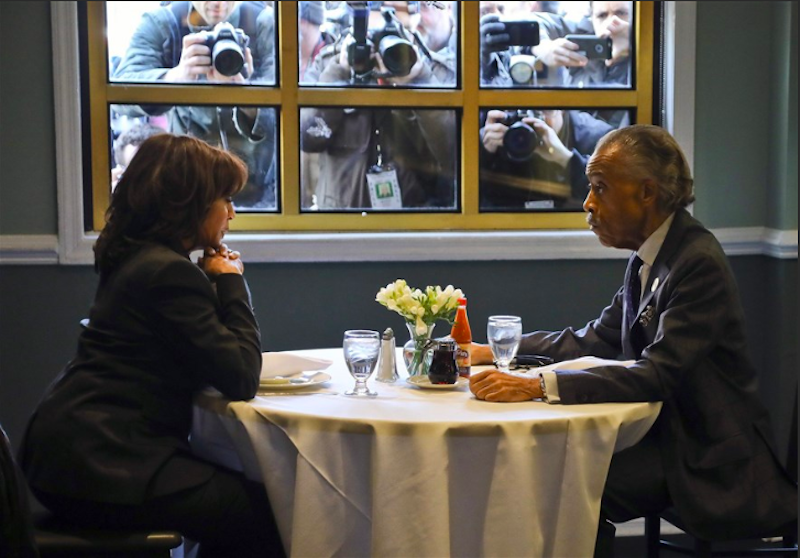
A month after California Democratic Sen. Kamala D. Harris announced her bid to become the first black female president, AP photographer Bebeto Matthews drew the press pool position to shoot a Feb. 21 meeting between Harris and Rev. Al Sharpton at Sylvia’s in Harlem. The famous soul food restaurant is the same one where Barack Obama and Bernie Sanders met with Sharpton to (unsuccessfully) seek his endorsement. Although Matthews’ photo would be shared, other New York photographers weren’t about to miss their shot. Matthews positioned himself inside and rose above a standard meeting image by including the photo pack outside, pressed against the cold window, to emphasize the importance of the historic sit-down.


Patrick Farrell, the curator of The Sunday Still, is the 2009 Pulitzer Prize-winner for Breaking News Photography for The Miami Herald, where he has worked since 1987. He is currently a Lecturer in the Department of Journalism and Media Management at the University of Miami School of Communication.

Friday, June 24, 2016

NEWSMAN: Join Tim Chapman On His Next Adventure June 25!

Voted Best Museum Exhibit by Miami New Times 2016! 

NEWSMAN: The Photojournalism of Tim Chapman

Join Tim on his next adventure! See ‪#‎NEWSMAN‬ like never before on this no-holds-barred tour by the legend himself. With over 4 decades of stories to share, we promise this afternoon full of Tim Chapman's real-life encounters will be better than most fiction you can recall. Don't miss it. Limited spaces available.
WHEN: Saturday, June 25, 2016 from 1:00 PM to 2:30 PM (EDT) at 

HistoryMiami Museum  101 West Flagler St. Miami, FL 33130
ON EXHIBIT: April 15, 2016 - August 14, 2016
For forty years, photojournalist Tim Chapman documented the history of South Florida and beyond. His career with the Miami Herald began in 1972, ended in 2012, and included coverage of The Jonestown Massacre, the Mariel Boatlift, the Cocaine Cowboys era, and Hurricane Andrew, among other local and international events. In 2013, Chapman donated his life’s work to HistoryMiami Museum, and Newsman showcases images from this collection, selected by longtime Miami Herald photographer Al Diaz. The displayed images, along with cameras, press passes, notebooks, and other artifacts, chronicle Chapman’s storied career.
Journalist, columnist and novelist Carl Hiaasen in a conversation with photojournalist 
Tim Chapman. Photo Matias J. Ocner

Opening Night with photojournalist Tim Chapman and exhibit curator Al Diaz

Reunion of fellow photojournalists from the Miami Herald, Associated Press and the Miami News. 
Photo Matias J. Ocner

Photo by Matias J. Ocner

Wednesday, November 20, 2013

Photographer Jeffery Salter: Allen West “Guardian of the Republic”

Former Miami Herald photojournalist Jeffery Salter blogs about his photo session with former member of the United States House of Representatives Allen West for book cover of "Guardian Of The Republic".

When the retired Lt. Colonel Allen B. West roared up to the studio and drove his Honda VTX 1800R retro cruiser inside, my team didn’t know if they should salute or run for cover.
Miami celebrity and portrait  photographer Jeffery Salter
Allan West “Guardian of the People” book cover by Jeffery Salter | Miami Florida
When I mentioned to Rep. Allen that I personally preferred BMW motorcycles, it could have been a constitutional crisis, but we managed to get past that by having both grown up as Army Brats, West’s father was a War World II veteran and so was mine. When West was in the military he was stationed at Fort Hood, Texas which sits next door to an old Sante Fe railroad depot town named Killeen, Tx. which was named after Frank P. Killeen, a manager of the railroad. And that’s where I grew up, throwing newspapers, working at Taco Bell and shooting photos for Ellison High School year book. Go Eagles. Anyway I digress.
I was commissioned by Random House to photograph the take no prisoners, former paratrooper, master Scuba instructor and former member of the United States House of Representatives Allen West.
We chose a very direct approach to the visual style of the photograph. Hard light, minimal shadows and crisp focus to match the personality and the tone of this straight shooting book which is filled with prescriptive politics…basically giving his views on how to overhaul government.
This is an outtake which I toned differently. It’s funny how with time we feel an image differently.
Miami celebrity and portrait photographer Jeffery Salter
Allan West “Guardian of the People” book cover by Jeffery Salter | Miami Florida
Photographer: Jeffery Salter
Art Director: Michael Nagin
Stylist: Melissa Kitchen
Groomer: Olivia Senghor

Wednesday, April 17, 2013

Pulitzer-Prize Winning Photojournalist Patrick Farrell Exhibits in Miami Shores


Photographic exhibit by Pulitzer-Prize winning Miami Herald photojournalist Patrick Farrell featuring dramatic imagery from Haiti and the Caribbean at Brockway Memorial Library Friday, April 19 from 6:30-8pm in Miami Shores, 10021 NE 2nd Avenue.

Sunday, January 6, 2013

Flashes of 2012

The Miami Herald asked staff photographers to submit images from the past year that meant the most to them, and to share their thoughts. Scroll down to see their picks. 
Al Diaz

A bombardment of 25,000 tomatoes (10,000 pounds) was launched by a mob on Saturday, Feb. 11. Tobacco Road, Miami’s oldest bar, provided the tomatoes for the city’s first Tomato Smash and Bash. Even covered in protective plastic, my camera gear and I ended up coated with tomato paste. I felt a bit tousled, like a bowl of spaghetti. 

Veteran Miami Herald staffer Al Diaz, 54, is a member of the Herald news team that won the 1993 Pulitzer Prize Gold Medal for the newspaper’s coverage of Hurricane Andrew. Diaz earned his journalism degree from the University of Florida in 1983, and was hired by The Herald upon graduation. He is a first generation Cuban American. Diaz and his wife, Cindy Seip-Diaz; their children, Angelika and Bartek; and several pets make their home in Coral Gables. 

Marice Cohn Band 
It’s always a challenge for me to shoot sailing because I really know nothing about the sport — only that it’s beautiful, fast, and always surprising. Such was the case with the swift crossing of three sleek sails during this past year’s Rolex competition on the waters of Biscayne Bay, Jan. 27.

Marice Cohn Band has been a photographer at The Miami Herald since 1979. A native of Miami, Cohn Band graduated from Florida International University with a BFA in photography. As well as working full-time at The Herald, she has been a Girl Scout leader for 21 years in Miami Beach, where she lives with her husband, Michael. She is the proud mother of three daughters: Jessie, Samantha and Alexandra. 


C.W. Griffin
Sports photography is a challenge that requires skill, reflex, game knowledge and a little luck. When all those things come together, the photographer has a chance to capture an extraordinary moment — like this one, a touchdown celebration involving the Miami Dolphins’ Daniel Thomas, (33), Charles Clay (leaping, foreground) and Davone Bess (partially obscured) during a November game against the Seattle Seahawks. Covering a game is like going fishing: There will be opportunities to catch a big one. Your job is to seize them. 
C.W. Griffin, has been a staff photographer at The Herald for the past 29 years. His work has appeared in National Geographic, Smithsonian and Time, and in multiple volumes of the Day in the Life photo book series. He has taught at the University of Miami for more than 10 years, and also teaches at the Little Haiti Cultural Center with Iris PhotoCollective. While serving in the military, he was the first African American to be named military photographer of the year for all branches of service. 


Peter Andrew Bosch
Michael Hadler is called safe at home during a Miracle League game in Pembroke Pines last August. The league is for kids with disabilities. The joy on their faces as they scored was inspirational. So too were the cheers from their parents. 

 Peter Andrew Bosch, born in Sunderland, England, has been at The Herald since July 4, 1983. He attended the University of Kansas, where he received a degree in design. 


Charles Trainor Jr. 
My favorite image is from the Miami Heat’s 2012 media day. I had LeBron James squeeze a basketball. Later we Photoshopped the Earth into the picture. On the final squeeze, he roared like a lion, and the room went silent.

Charles Trainor Jr. joined The Miami Herald in 1981, and has shot most of the major news events that have impacted South Florida in recent decades. Highlights include his images of the Cuban rafters’ exit of 1994, the wreckage left by Hurricane Andrew and a project called ‘The Corridor’ that chronicled life in a section of South Florida over 18 years. 


Walter Michot 
I love photography and I love horticulture, so this was a great assignment for me. Angles, size, relationships and timing are the daily challenges of a photographer. It was June 6, 2012, a Wednesday morning. Approximately 40 really old trees were being dug up and moved from the old Brickell Tennis Club, future site of Brickell CitiCentre, to the under-construction MAM/Museum Park at Bicentennial Park. This image shows a tree-bearing barge moving north through the Florida East Coast Railway Bridge. 

Born and raised in Fort Lauderdale, Walter Michot attended Chaminade High School and went on to major in psychology and management at Loyola University of New Orleans and Florida State. While awaiting a job with the state of Florida, he decided to pursue his hobby of photography as a profession. He has been shooting pictures in South Florida for 39 years, 29 of them for The Herald.

Emily Michot 
This photo was shot in March on yet another media tour of the new Miami Marlins Park. This particular tour was for the media to sample and photograph the ballpark food, but when I saw these workers cleaning the windows, it made for a much better picture. 

Born in Fairbanks, Alaska, Emily Michot has been a staff photographer for The Herald for 17 years, and still loves every moment of it. Michot first acquired a passion for photography as a child in her father’s darkroom as he took photos and developed them for the Air Force as a public affairs officer. Michot later studied photography at the University of Florida and the Art Institute of Fort Lauderdale. Michot is married to Walter Michot, also a Herald photographer, and they have two sons. 


Patrick Farrell 
Nearly three years after Haiti’s devastating earthquake on Jan. 12, 2010, Catiana Pierre, 11 ( left), and her brother Dickenson Prudhomme, 6, take cover from the relentless rain of Tropical Storm Isaac last August. Wind and rain from the storm collapsed their family’s tent-home the night before. The children escaped up a nearby hill to watch the rising water of the Riviere Grise, which runs by the Marassa 14 Tent City and serves as a constant reminder of Mother Nature’s threats to recovery efforts. 

Patrick Farrell has been a photographer at The Miami Herald since 1987. He was the recipient of the 2009 Pulitzer Prize for breaking news photography for his images of Haitian storm victims. Farrell graduated from the University of Miami in 1981 with a major in film. He grew up in Miami, the seventh child in a family of 12. He is married to writer Jodi Mailander Farrell, and they have two daughters: Annie, 13, and Lucy, 12. 


Marsha Halper 
On Aug. 31, The Miami Herald photo staff was issued a challenge: find a page one-worthy image reflecting the start of the Labor Day weekend. Months earlier, at Miami International Airport, I had seen this beautiful, multi-hued wall of windows, part of a sound-and-light installation, and made a mental note to return to photograph it when the time was right. It was worth the wait: My photo of travelers at MIA making a colorful entrance to the holiday weekend ran prominently on our front page the next day. 

Marsha Halper has been a Miami Herald staffer since 1985. She was born in Baltimore, and is a graduate of Guilford College in Greensboro, N.C. Her work has been featured in Time, Newsweek and Mother Jones magazines, and was selected for the 1985 Hortt exhibition at the Museum of Art Fort Lauderdale, and for a 1988 show at the St. John’s College gallery in Santa Fe, N.M. 


Carl Juste 
 “Death is always harder on the living” — those words have come to mind so many times over the years that it is almost a cliché. On Dec. 14, 2012, the nation endured what seemed to be the breakpoint — the Sandy Hook Elementary School shooting that killed 20 children, brought the nation and its newly reelected president to tears and reignited the debate over gun control. For many in South Florida, gun violence has become the norm, with arguments and lovers’ spats resolved with the pull of a trigger. On Nov. 20, less than a month before Sandy Hook, 13-year-old Lourdes Guzman-DeJesus was riding in a school bus with her younger sister and seven other children when another student took a gun out of his book bag and accidentally shot her in the neck. The .40-caliber handgun came from his home. While covering Lourdes’ funeral, seeing her mother Ady Guzman-DeJesus weep inconsolably over the casket, another phrase came to mind — “Lost but not forgotten.” 

 Born in Port-au-Prince, Carl Philippe Juste came to the United States with his politically active family in 1965. Raised in Brooklyn, he arrived in Miami in 1973, earned a bachelor’s degree at the University of Miami and has worked at The Herald since 1991. Assignments have taken him to Pakistan, Iraq and Afghanistan, as well as to the nation of his birth. Juste is co-founder of Iris PhotoCollective, a collaboration to create a new context for exploring and documenting the relationship of people of color to the broader world. 

Saturday, December 29, 2012

Miami Herald Photojournalist Tim Chapman Retires

Illustration by Marco Ruiz     


By Al Diaz
aldiaz305@aol.com

Smack in the middle of Miami’s Cocaine Cowboys and their illegal drug trade I decided to buy a police scanner. Within hours, the purchase propelled me into harms way, launched my career and allowed me to meet photojournalist Tim Chapman.

The year 1979, a lone Miami Police officer staking out a Little Havana home calls for back up when the suspects inside decide to flee with their illicit drugs. Not far to drive from my childhood home, I arrive hearing sirens blaring, tires screeching and see guns everywhere.

Miami Police check Tim Chapman's credentials in 1979.
In the middle of all this madness I see a photographer in the middle of the street standing face-to-face arguing with a cop. I shoot a picture. The officers supervisor approached the rookie cop and said to leave Chapman alone, he’s seen more action than you have.

The next day Chapman’s photos are spread across the front page of The Miami Herald and mine on the AP wires.

After 40 years on the job, Tim Chapman is retiring from The Miami Herald on December 31. He’s covered wars, hurricanes, riots, earthquakes, mass exoduses from Cuba, kidnappings, plane crashes, death and mayhem including Guyana’s Jonestown massacre in 1978.

He’s been on vacation this week, Chapman’s last day on the job actually working? December 21, just in case the Mayan Prophecy of an apocalypse were to come true and it needed to be covered.


Photo By Bill Cooke    
By Carl Hiaasen
Miami Herald Columnist
Friend and Accomplice
There’s not enough space on this page for every Tim Chapman story, but most are true. He’s been a legend in this business for decades. With retirement he ascends to mythic.

Yes, he once drove cross-state in a Herald van with a loaded gun, a bloody knife and a severed alligator tail. Yes, he once used the lens of a company Nikon to batter some macho fool who’d tried to push him off of public property. (Tim then straddled the poor twit and snapped off 36 frames.)

Yes, he once tested an electric dog collar on himself before fitting it on his Labrador. (The sight of Tim flopping on the kitchen floor was all that the dog needed to see; from then on, the animal came running whenever Tim called).

And, yes, he once paid a voodoo priestess in Haiti to put a curse on an unpopular photo editor back in Miami -- and, yes, it worked.

The line between fearless and crazy is hazy, and sometimes we weren’t sure if Tim had crossed over. It wasn’t because of a death wish that I always asked to ride with him; I just knew that he always went where the big news was. Always.

One afternoon, during one of Miami’s bloody episodes of civil unrest, Barry Bearak and I rode into the riot zone with Tim, who wore a flak jacket and told us to stay low in our seats because of the sniper fire. Whenever he’d jump out to shoot pictures, we’d dart around interviewing bystanders.

After about an hour Tim decided he was in the mood for (I swear to God) watermelon. So he screeched to a halt beside a fruit stand on one of those smoldering streets, and there he purchased two freakishly large melons.

As he walked back toward the car – and he took his sweet time – Barry and I were debating which of us was going to drive after Tim got shot.

He didn’t even get grazed, of course, because he always knew how long to stay, and when to run. Once we were in a Nassau crack house talking to (who else?) crackheads, when Tim turned to me and quietly said, “It’s time to go.”

Our interview subjects had been speculating as to the potential resale value of Tim’s camera gear and, unknown to me, two of them had gone to a bedroom to get guns. Tim and I took off, only to find that our driver had already fled the neighborhood. 

Most important: The photos that Tim took inside that house, way before crack cocaine ever reached America, were phenomenal.

Wise photo editors let Tim do what he did best, which was cover the news. The one radio dispatch guaranteed to pitch him into a seething rage: “Hey, Tim, we need some feature art.”

You did not send Chapman to take pictures at Art Basel. You did not send him to shoot a Dolphins game. You did not send him to the freaking Silver Knights.

You sent him to fires and wars and plane crashes and mass suicides in Guyana. You sent him to crawl the jungles of Nicaragua with armed rebels. You sent him to shoot the guarded island mansion of a crooked prime minister (where he rented a plane and flew in low “with the sun at our backs”).

You sent him to a triple-homicide in Medley (or was it a quadruple?), where he bustled around as cheerily as Martha Stewart in an herb garden. I remember because I was there.

Nobody who ever set foot in the Herald newsroom loved hard news more than Tim Chapman, or fought harder to get it into the paper. The business has changed, but Tim never did, never would.

And those of us who got to ride with him in those kick-ass days cherish every harrowing memory.

Tim Chapman's send off party at The Miami Herald                                      Photos By Al Diaz
Rick Hirsch with a Miami Herald spoof page for Tim Chapman 


Jordan Levin with Tim Chapman

David Landsberg, President and Publisher with Chapman

Photo Editor David Walters hands Chapman a cigar lighter.
The boss, Roman Lyskowski hands Chapman a copy of  The Exile Experience
on the Cuban Exodus.
Chapman plunges a cigar in his going away cake and mocks lighting it up.


Friday, December 28, 2012

Buy an iPhone, voila, you are a photojournalist!


"A billion roaming photojournalists" How do I compete against that? Who needs a four-year photojournalism degree? Buy an iPhone, voila, you are a photojournalist!

Here is the latest iPhone 5 commercial from Sprint.


This post is not a commentary on photojournalists using iphones as a tool.

It is meant to highlight the Sprint video and comment on the language used in an advertisement to achieve a desired effect on people. It implies that a consumer is a photojournalist just because they are using an iPhone 5 to take photos and post photos on social media.

I am sorry but if I buy a hammer does that make me a carpenter?
If I buy a thermometer, voila, I am one of a billion roaming doctors?

Consumers have been using cameras for over a century. I don't recall anyone ever calling these consumers, who share their photos, as photojournalists.

Photojournalism is distinguished from other close branches of photography (e.g., documentary photography,social documentary photographystreet photography or celebrity photography) by complying with a rigid ethical framework which demands that the work is both honest and impartial whilst telling the story in strictly journalistic terms. Photojournalists create pictures that contribute to the news media.  
Source: Wikipedia